EdTech & Cybersecurity · AI · 2025
Cacilian Academy
An AI-enhanced LMS integrated with the Prescient Security ecosystem that automates course creation and specialized security training.
- Next.js
- PostgreSQL
- OpenAI
- less manual content creation time
- 60%
- less manual content creation time
Overview
Cacilian Academy is the training platform at the center of the Prescient Security ecosystem. It's a full Learning Management System (LMS) that lets organizations digitize expert knowledge and deliver it as structured, measurable training. AI handles the slowest parts of course production, structuring the content and generating assessments, so specialized training in high-compliance fields like cybersecurity can scale.
We designed and built the LMS from the ground up. That covered the data architecture for courses and assessments, the AI content pipeline, authentication and role-based access, and the dashboards administrators use to track progress and certify completion.
The challenge
Security expertise is valuable and hard to scale. Turning it into courses was slow, manual work. Instructors drafted outlines by hand, wrote every quiz question themselves, and rebuilt material whenever the underlying guidance changed. For administrators, little was visible once a course launched: who had progressed, where teams were struggling, and who was ready to be certified.
Several things made this harder than a typical LMS:
- The content is technical and nested. Security courses span modules, lessons, multimedia, labs and quizzes at several levels. The data model had to represent that hierarchy cleanly.
- The material is sensitive. Internal security guidance and training content can't be open to everyone in the ecosystem. Access had to be granular.
- AI output has to be usable. Generated outlines and questions only save time if instructors can trust, edit and publish them, not rewrite them.
Goals
- Turn technical documentation into structured courses and assessments with far less manual effort.
- Support complex course hierarchies with multimedia content and nested quizzes.
- Protect training materials with strong authentication and fine-grained, role-based permissions.
- Give administrators real-time visibility into progress, knowledge gaps and certifications.
- Make it fast to roll out new training modules across the ecosystem.
Our approach
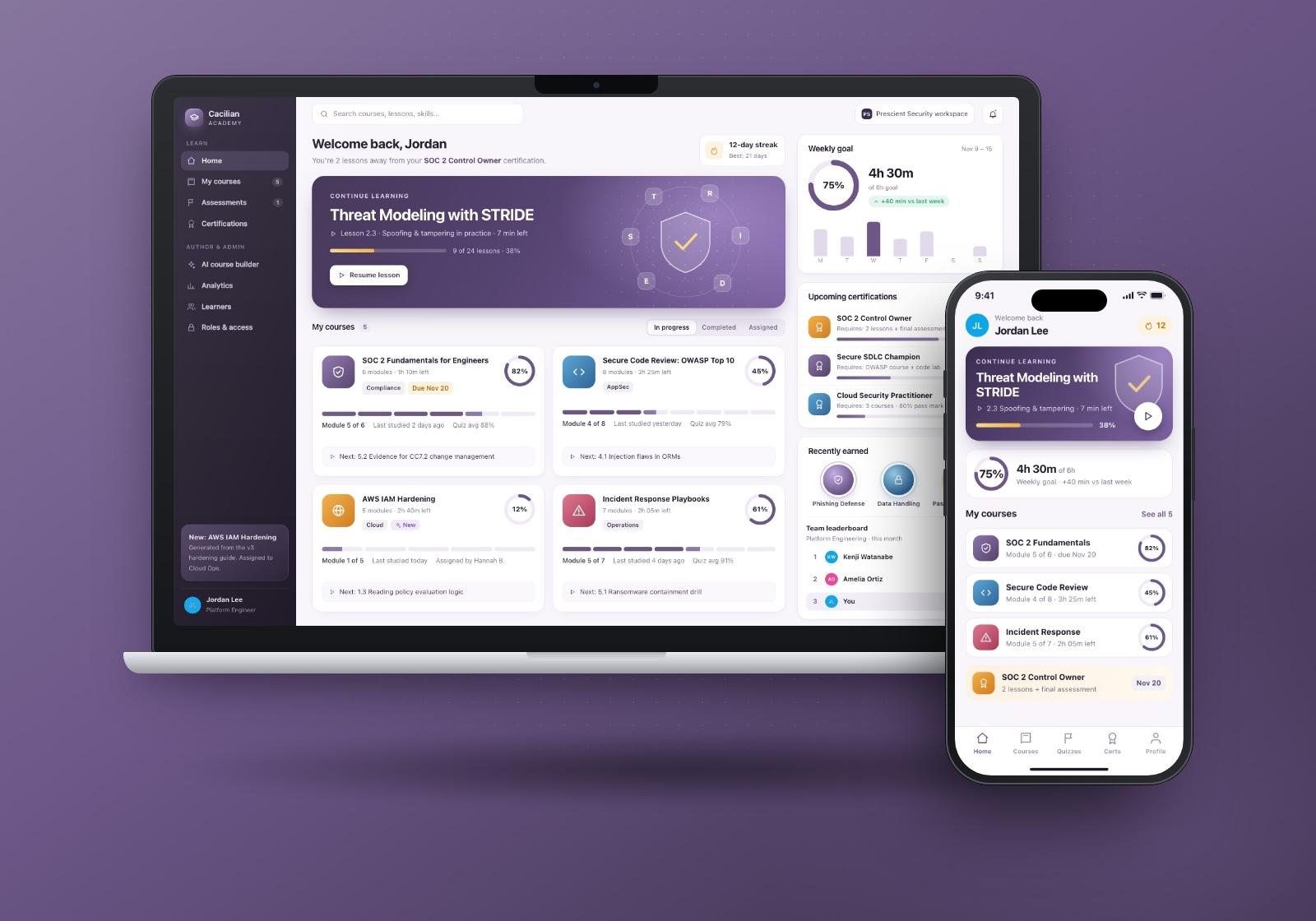
We split the product into two clear areas: Learn for learners, and Author & Admin for instructors and administrators. Learners see what to do next: continue a lesson, finish an assessment, earn a certification. Authors and admins get the tools to produce content and measure its impact. Role-based access controls who sees which area, down to individual courses.
For the AI, we kept the instructor in the loop. The course builder works in clear steps (source document, outline, quiz, publish), and every generated item can be reordered, edited or regenerated before anything goes live. Generated questions link back to the page of the source document they came from, so instructors can check them against the original material.
Underneath, we built a modular architecture. Courses are assembled from self-contained modules, lessons and assessments, so a new security training module can be generated, reviewed and deployed across the ecosystem without restructuring existing content.
What we built
Learner home
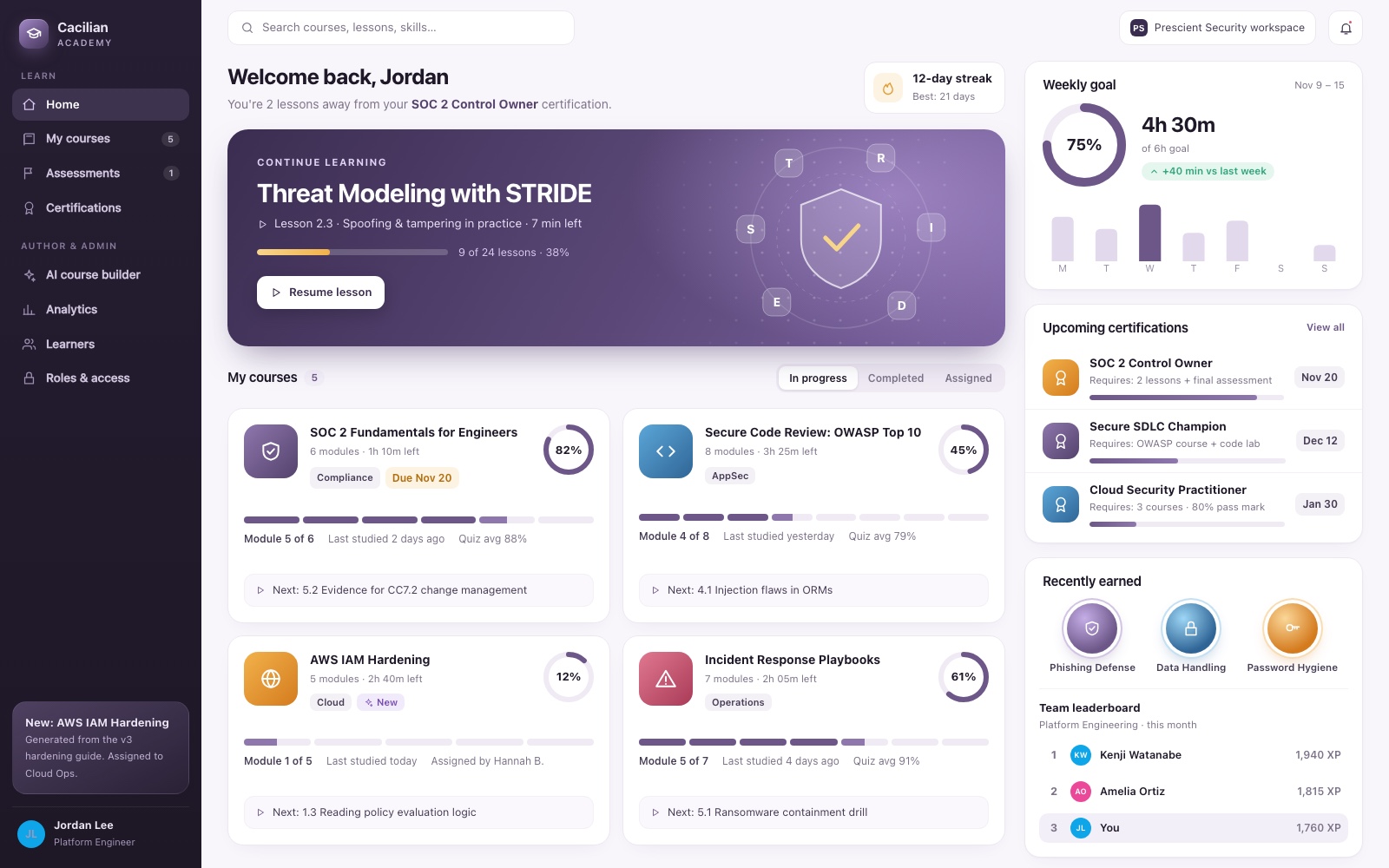
The learner home shows enrolled courses with progress rings, the next lesson in each course, and upcoming certifications with what's still required to earn them. A weekly goal, streaks and recently earned badges keep momentum going, and a prominent card resumes the lesson in progress.
Course player
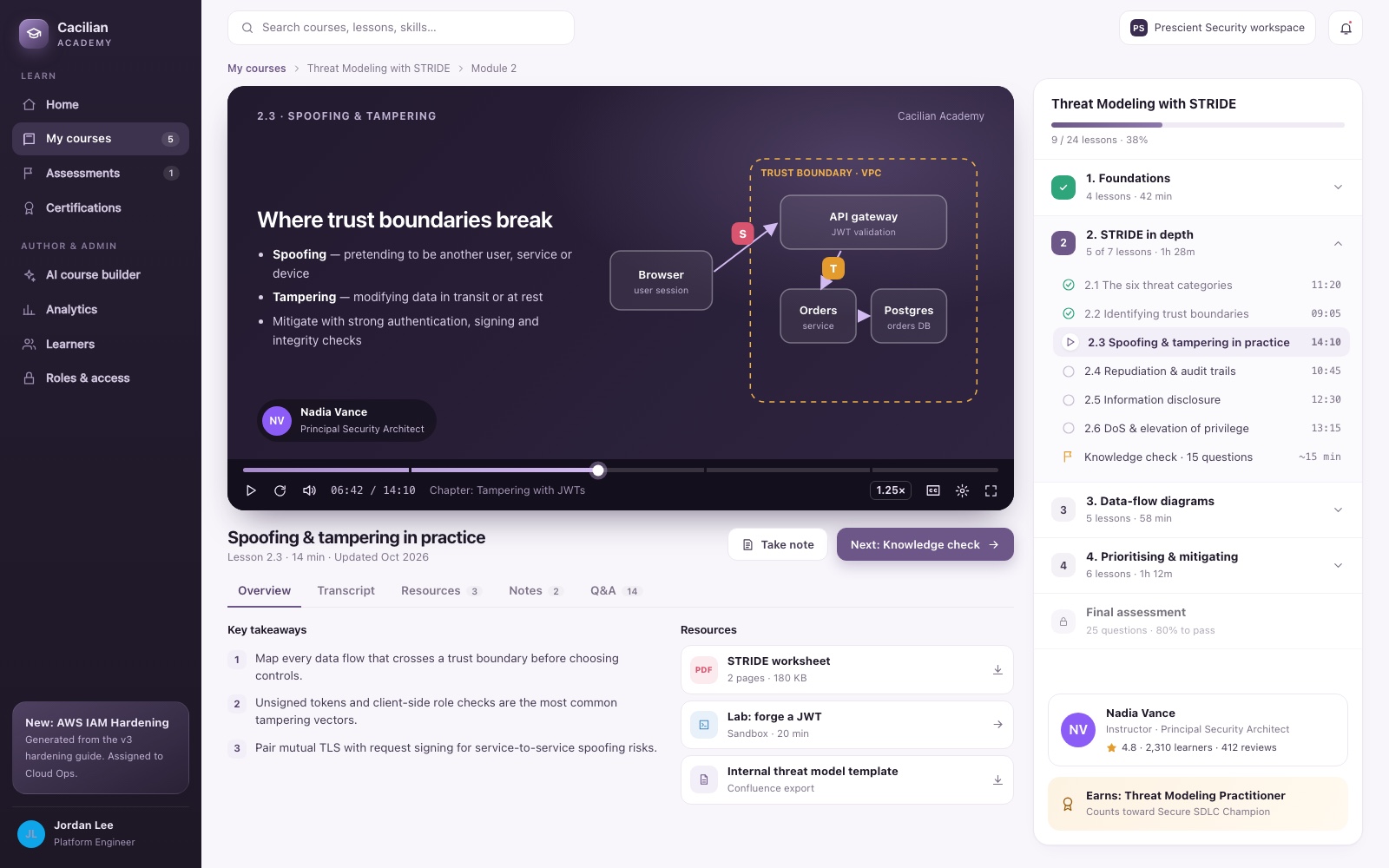
Lessons play in a focused course player with a module sidebar that tracks completed lessons and the knowledge checks ahead. Under the video, learners find key takeaways, a transcript, downloadable resources, notes and Q&A. Each lesson also shows which certification it counts toward.
AI course builder
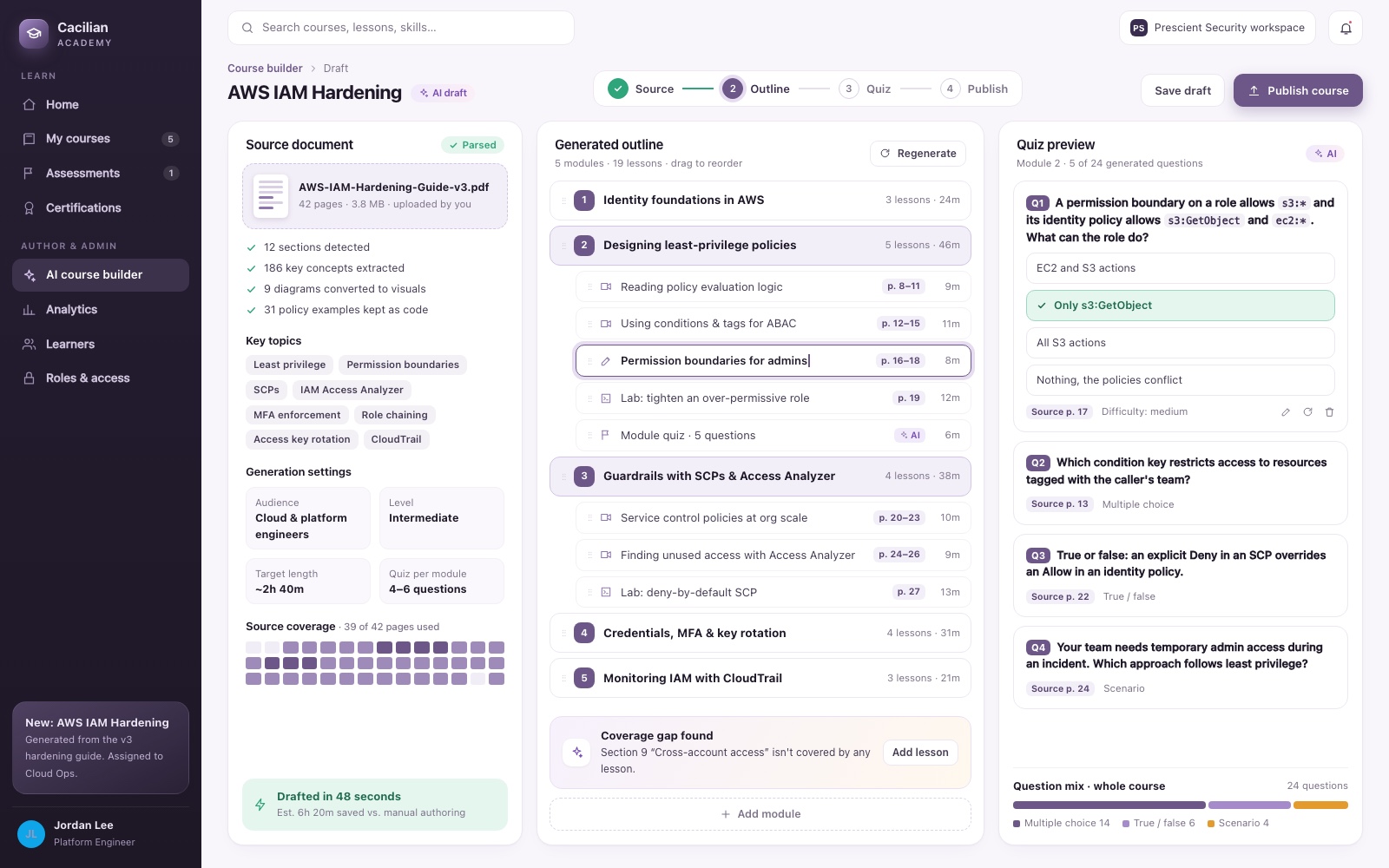
This is where most of the time savings happen. An instructor uploads a technical document, such as a cloud identity hardening guide. The AI parses it into key topics, drafts a structured outline of modules and lessons, and generates quiz questions for each module. Instructors set the audience, level and target length, then edit before publishing.
- Source parsing that extracts sections, key concepts and examples
- Generated outline with drag-to-reorder lessons and source page references
- Quiz preview with mixed question types, each traceable to its source page
- Coverage checks that flag parts of the document no lesson covers yet
Assessments
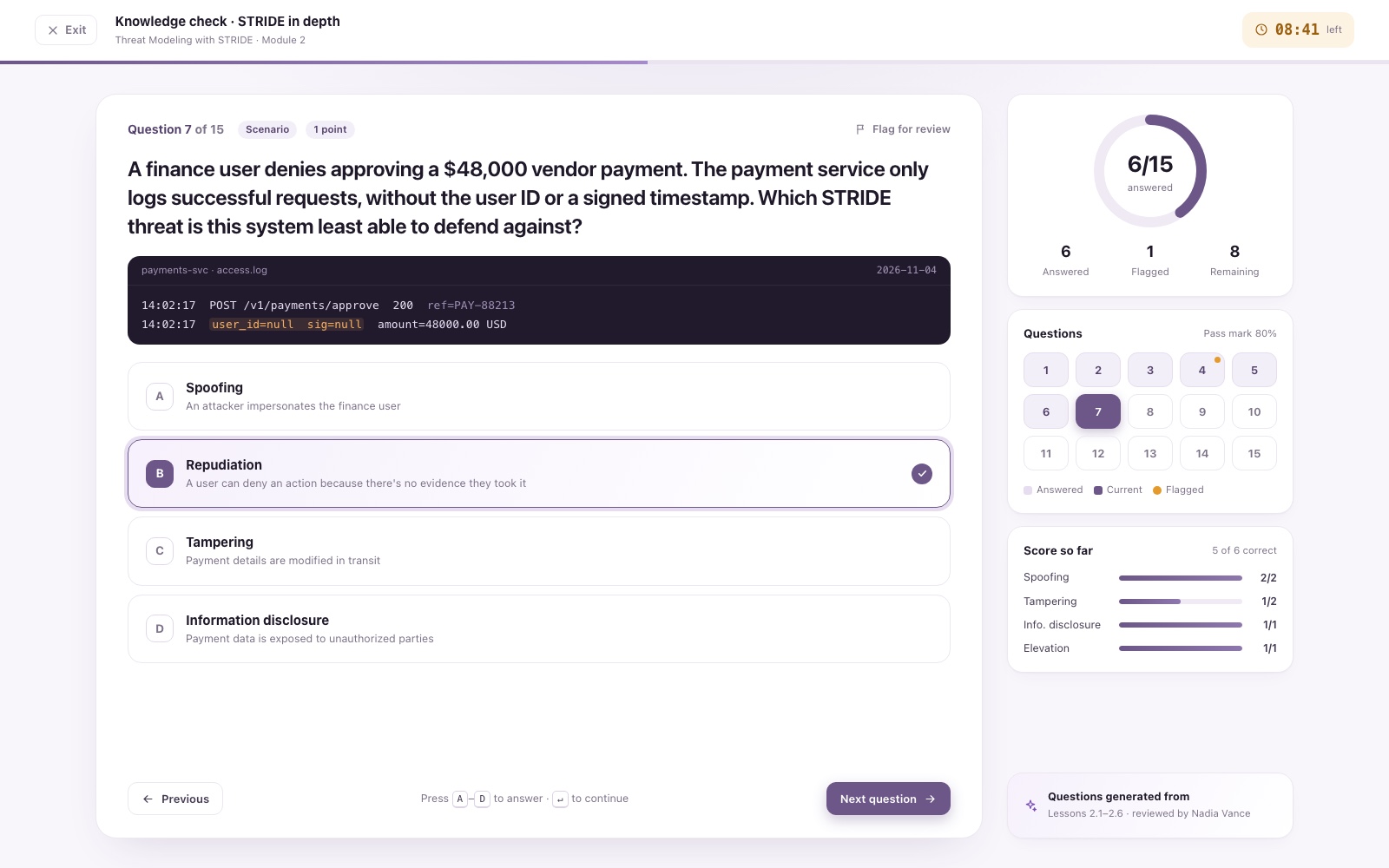
Knowledge checks are built for focus. Each question appears with its options, scenario-based context where relevant, a timer and a question navigator showing answered and flagged items. Learners see their score by topic as they go, and the screen notes which lessons the questions were generated from and who reviewed them.
Admin analytics
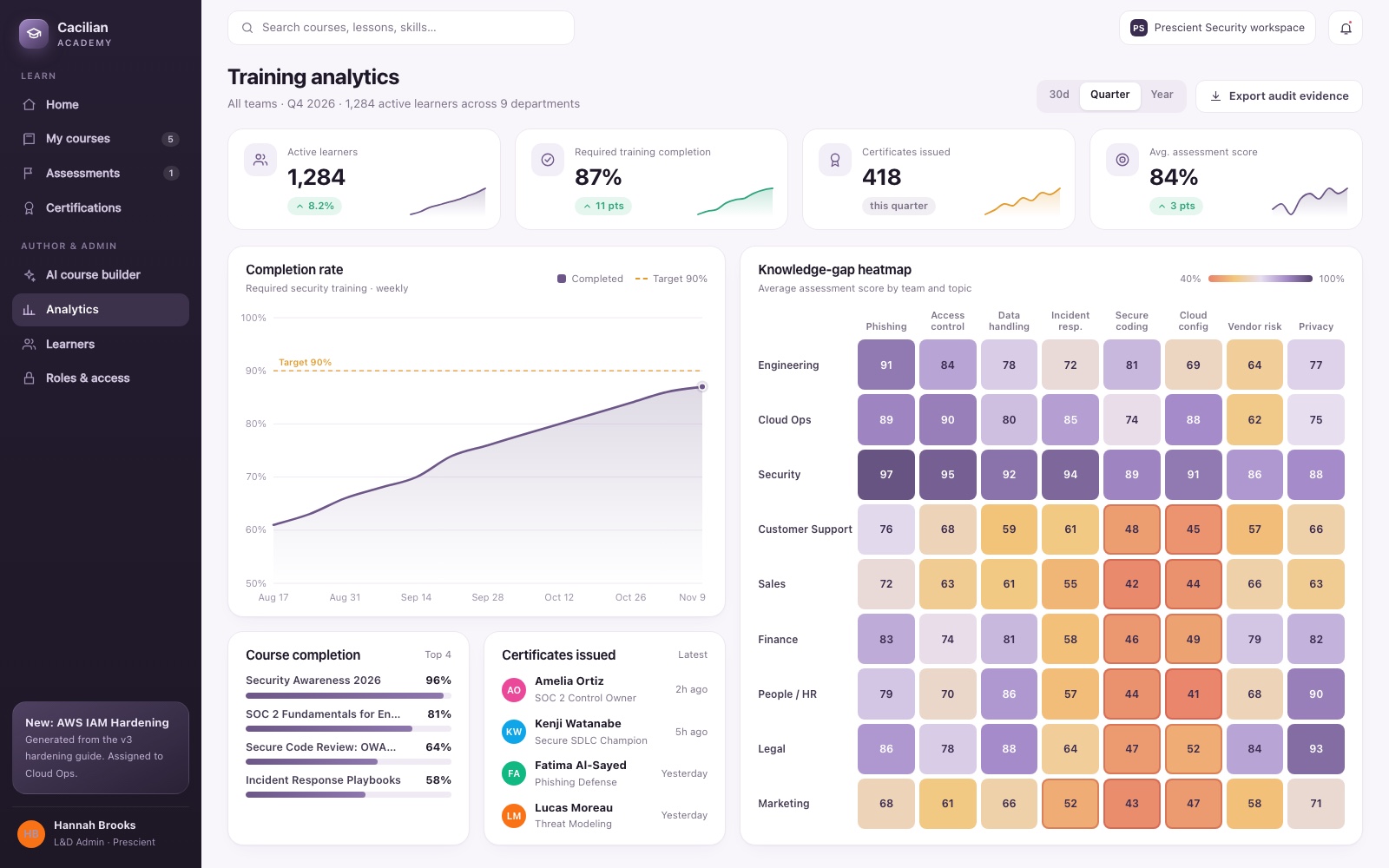
Administrators get real-time dashboards covering active learners, required training completion, certificates issued and average assessment scores. A knowledge-gap heatmap breaks scores down by team and topic, so it's obvious where to focus the next round of training. Completion trends and recently issued certificates sit alongside.
Under the hood
- LMS architecture from scratch. We designed the database schema for complex course hierarchies, multimedia content and nested quiz structures. Modules, lessons and assessments are composable building blocks.
- AI content automation. AI models parse technical documentation and generate relevant quizzes and structured course outlines. The pipeline keeps references from generated content back to the source, so review is quick and grounded.
- Secure infrastructure. Strong authentication and granular role-based access control (RBAC) protect sensitive training materials and separate learner, author and admin capabilities.
- Real-time tracking. Progress and assessment results feed live dashboards that let administrators monitor learning, spot knowledge gaps and certify completion.
Results
- 60% less manual content creation time. AI-generated outlines and quizzes replaced most of the drafting work.
- More time on quality. Automated assessment lets instructors focus on content quality instead of writing quizzes.
- Scalability. The modular architecture deploys new security training modules across the ecosystem in minutes.
Cacilian Academy turns specialized security knowledge into training an organization can produce quickly, deliver securely and measure clearly.