Software Testing & QA · AI · 2021
AutonomIQ
An autonomous low-code platform using ML and NLP to turn plain-English instructions into enterprise-grade automation for Salesforce, ServiceNow and Oracle.
- Selenium
- Java
- script creation, down from days
- <1 hr
- script creation, down from days
- test maintenance productivity
- 8-10x
- test maintenance productivity
- faster feature release cycles
- 40%
- faster feature release cycles
Overview
AutonomIQ is an autonomous low-code platform for test automation in large enterprise SaaS environments. It uses Machine Learning and Natural Language Processing (NLP) so that non-technical users can generate, run and maintain automation scripts for Salesforce, ServiceNow and Oracle, without hand-writing or constantly repairing code.
We built the core of the platform. That includes the plain-English authoring experience and the NLP engine that turns it into Selenium/Java code, ML-based self-healing for scripts broken by UI changes, AI-generated synthetic test data, and native support for the dynamic, frequently updated enterprise environments the platform targets.
The challenge
Traditional test automation has two problems. Writing scripts takes deep coding expertise, which limits who can contribute. And the scripts are brittle: they depend on specific UI locators, so they break whenever the interface changes.
For large SaaS applications that change on a regular release cycle, this creates a "maintenance tax" that can consume up to 80% of a developer's time. Teams spent their effort keeping old tests alive instead of covering new functionality. Releases slowed down because regression testing couldn't keep pace. Test data was a risk too: realistic data tends to mean production data, which raises privacy concerns under regimes such as GDPR and HIPAA.
Goals
- Let people who don't write code author enterprise-grade automation in plain English.
- Remove manual script maintenance by repairing broken scripts automatically when the UI changes.
- Provide realistic test data without touching sensitive production records.
- Keep automation working through quarterly SaaS releases on Salesforce, ServiceNow and Oracle.
- Shorten the path from script idea to running test, and from feature to release.
Our approach
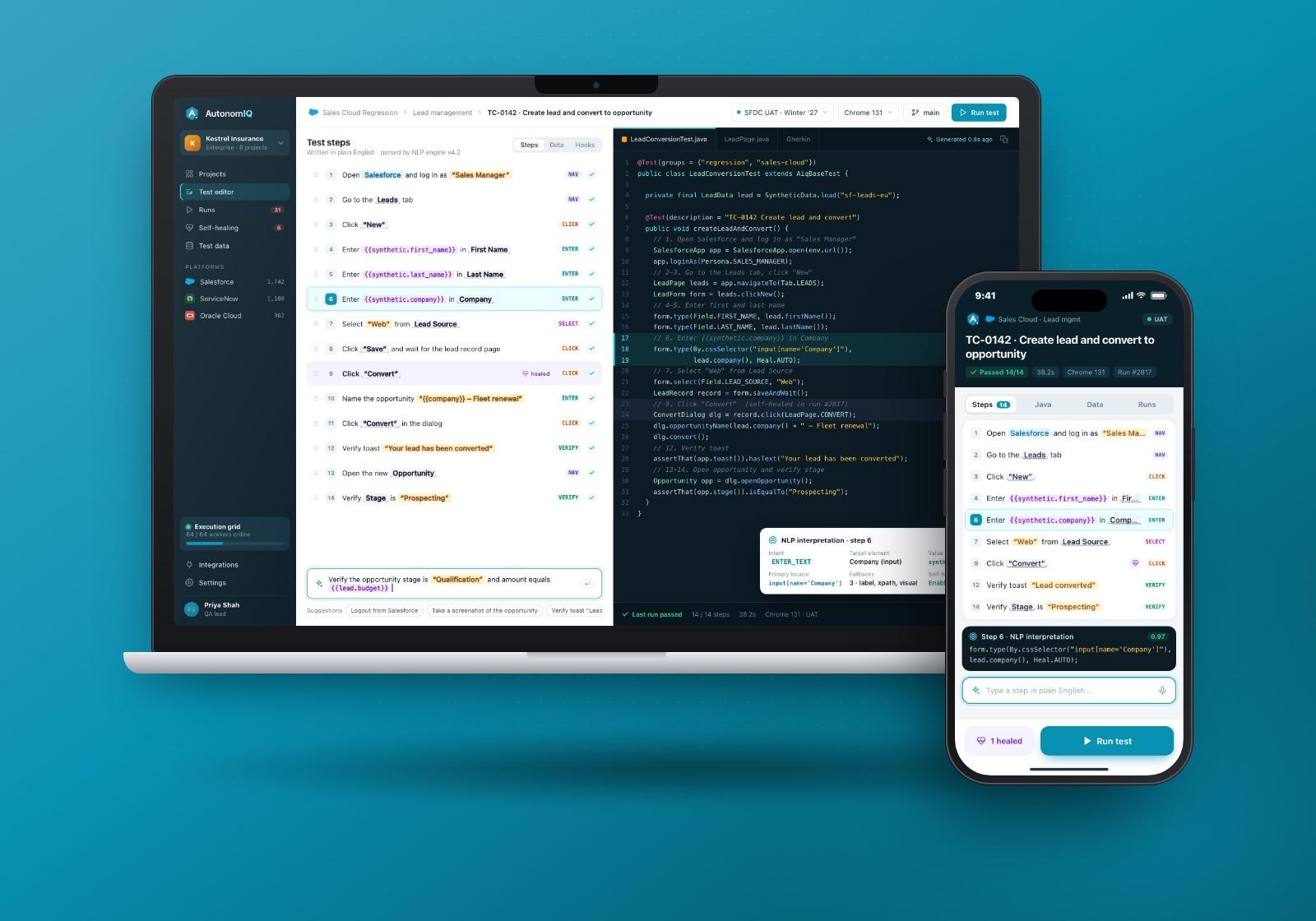
We designed AutonomIQ around intent rather than implementation. A test step describes what a user wants to do ("Login to Salesforce and create a new lead"). The platform works out how to do it and generates the code. Because intent is the source of truth, the generated code can be regenerated or repaired without the author touching it.
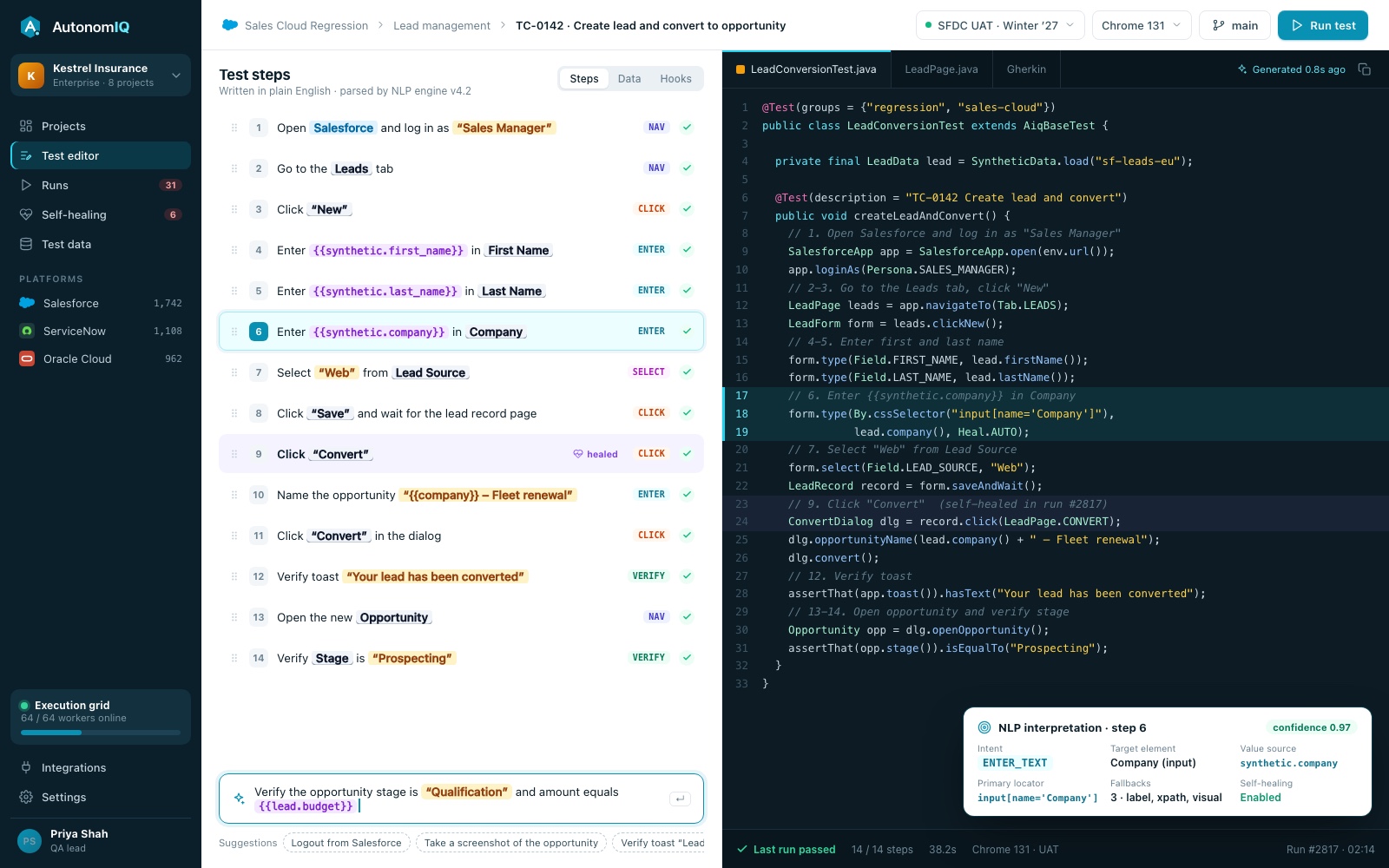
We kept the generated code visible. Plain-English steps sit next to real Selenium/Java, so engineers can inspect, trust and extend what the platform produces. This kept the platform credible with technical teams while opening authoring to everyone else.
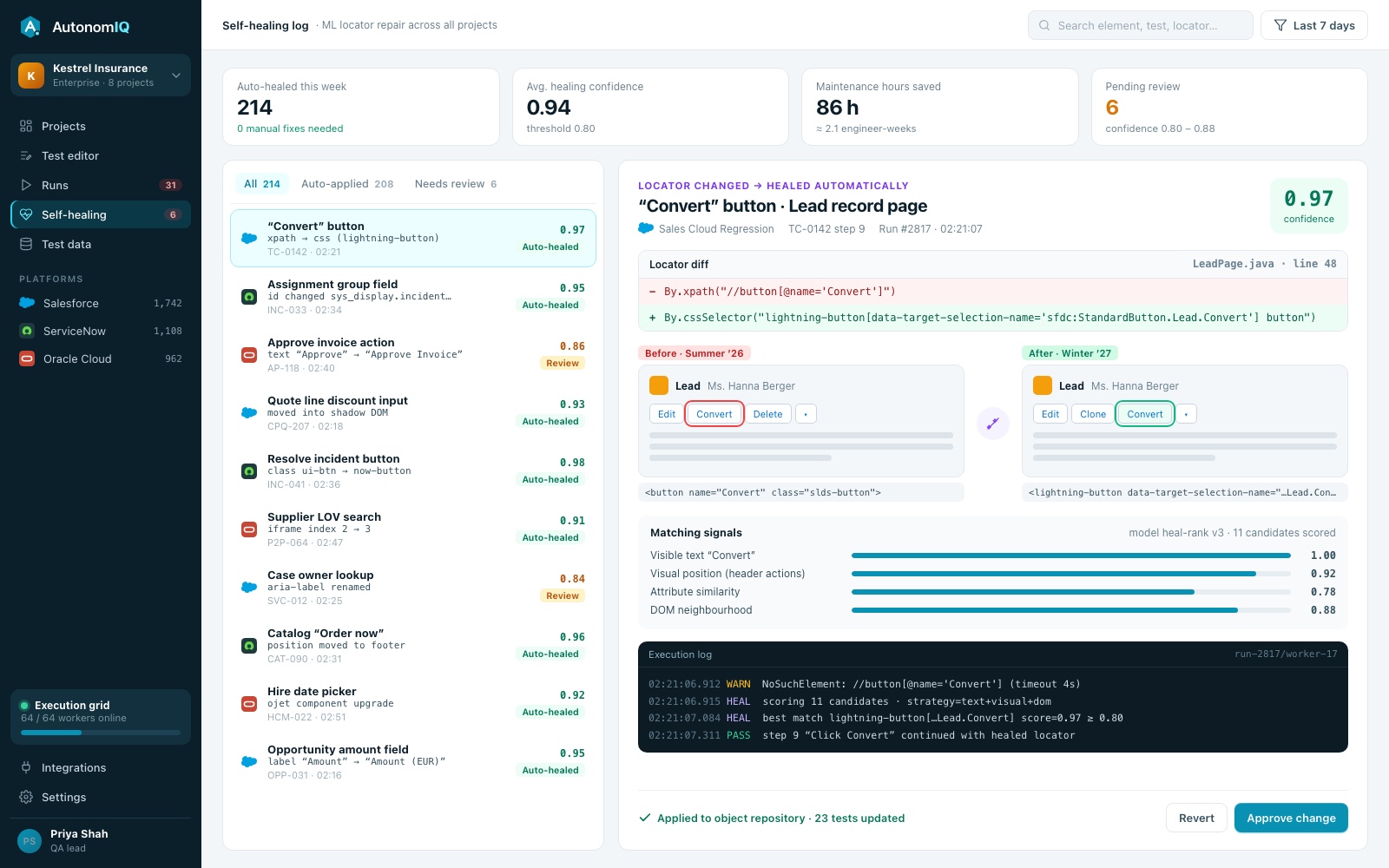
Self-healing was designed to be transparent. When a locator changes, the platform shows what changed, why it picked the replacement and how confident it is, so teams can audit repairs instead of trusting a black box.
What we built
Plain-English test editor
Users write test steps in natural language. The NLP engine interprets each step, works out the action type (navigate, click, enter, select, verify) and the target element, and generates the matching Selenium or Java code in a side-by-side panel. Steps can reference synthetic data fields, and an interpretation panel shows the detected intent, target element, locator strategy and fallbacks for any step.
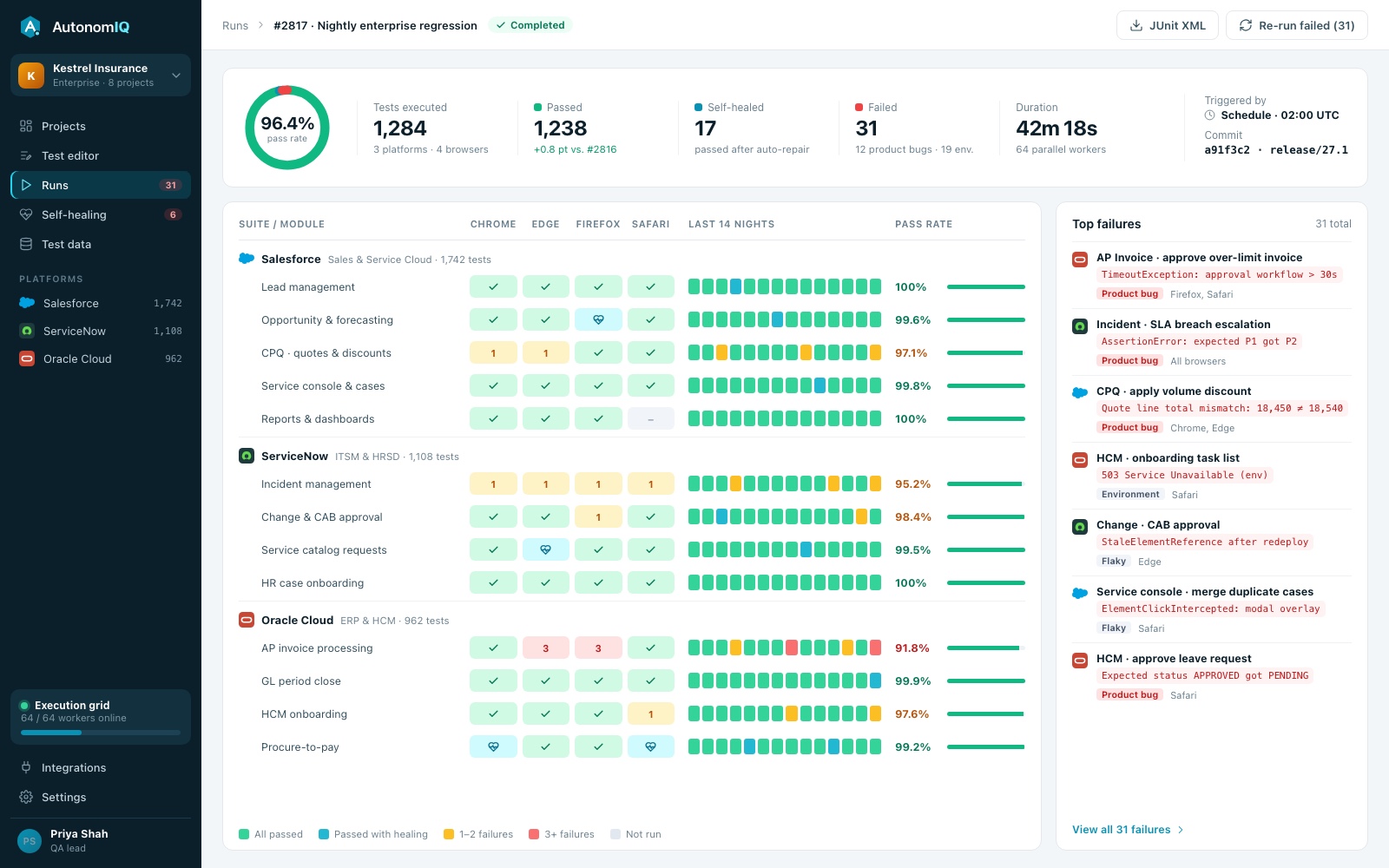
Test run results across platforms
Run results group suites by platform (Salesforce, ServiceNow and Oracle) and show a pass/fail matrix for each module across browsers, with a pass-rate history for recent nightly runs. Tests that passed only after automatic repair are marked separately. A failures panel classifies each failure, separating real product bugs from environment problems and flaky tests.
Self-healing log
When the application's DOM or UI changes, ML algorithms detect the break and heal the script in real time. The self-healing log records every repair. A locator diff shows the old and new selectors, before-and-after views show the element in both UI versions, and a breakdown of matching signals explains why the replacement was chosen. Lower-confidence repairs are held for human review instead of being applied automatically.
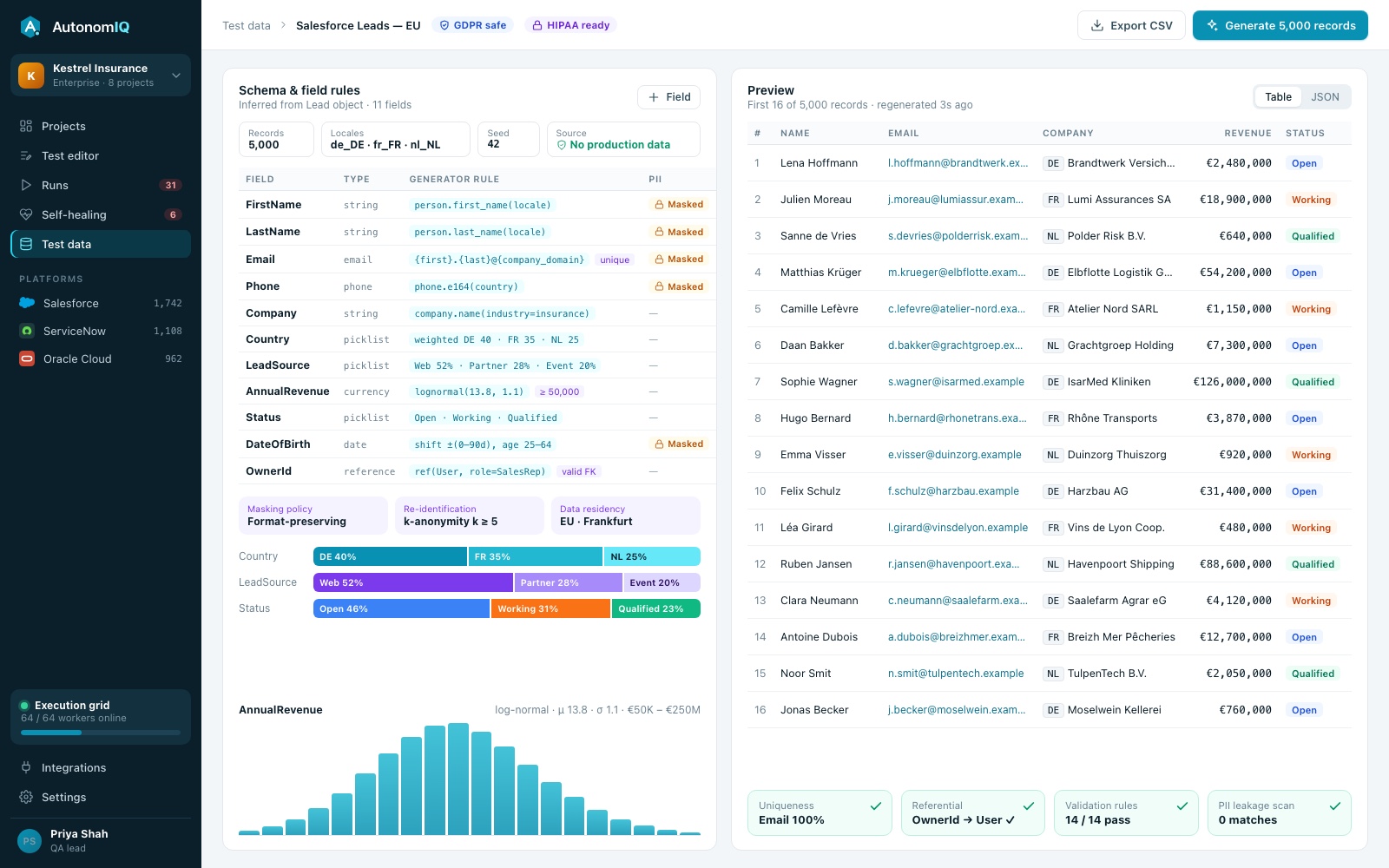
Synthetic data generator
The generator produces realistic, AI-generated test data that supports privacy compliance with GDPR and HIPAA without touching production records. Users define a schema with a generation rule per field, mark which fields count as personal data, and set distributions for values such as country or status. A live preview shows the generated records, along with validation checks such as uniqueness and referential integrity.
Projects overview dashboard
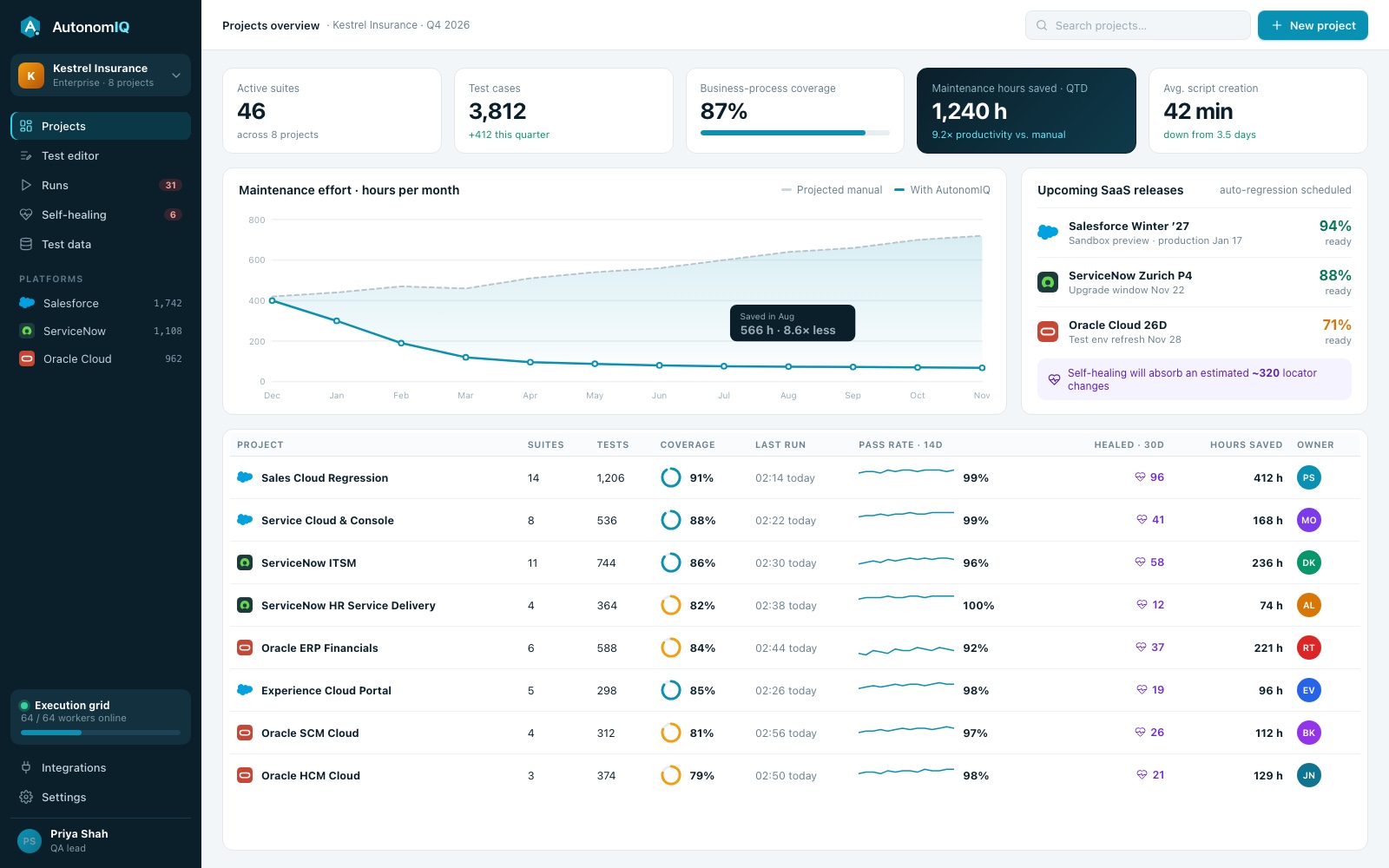
The projects dashboard gives QA leads a portfolio view: active suites, test cases, business-process coverage and maintenance effort over time compared with a manual baseline. It also tracks upcoming SaaS releases on each platform and how ready each regression suite is, so teams can see the next quarterly update coming.
Under the hood
- NLP-driven code generation. The NLP engine maps plain-English instructions to intents and target elements, then generates Selenium or Java code automatically.
- ML self-healing. ML algorithms detect changes in the application's DOM or UI at run time and heal broken scripts in real time, so manual locator maintenance goes away.
- Synthetic data pipeline. AI-generated test data is realistic enough for meaningful testing while supporting privacy compliance with GDPR and HIPAA, because sensitive production records never enter the test environment.
- Built for dynamic enterprise SaaS. Native support for complex, dynamic environments on Salesforce, ServiceNow and Oracle keeps automation current through quarterly SaaS releases.
Results
- Script creation in under an hour, down from days.
- 8x to 10x improvement in test maintenance productivity.
- 40% faster feature release cycles for enterprise clients.
AutonomIQ moved automation from a specialist skill to a team capability. Plain English became the authoring language, self-healing took the place of most of the maintenance tax, and synthetic data removed the trade-off between realistic tests and privacy. As a result, enterprise teams could keep their regression suites in step with fast-moving SaaS platforms instead of falling behind them.