Healthcare · Web · 2022
Medicta
A comprehensive Hospital Management SaaS designed to digitize healthcare operations and optimize the patient journey.
- fewer administrative errors
- 40%
- fewer administrative errors
Overview
Medicta is a cloud-based Hospital Management SaaS that modernizes healthcare administration. It brings intake, scheduling, patient records, department shifts and consultation queues into one platform, so providers can spend their time on patient care instead of paperwork. It is built to support institutions of all sizes, from a single clinic to a multi-site hospital.
We designed and built the platform end to end: a multi-tenant SaaS architecture, a real-time appointment booking engine with automated reminders, the staff-facing workspace and a patient booking experience on mobile.
The challenge
The hospitals and clinics Medicta serves were running on fragmented manual processes. Intake, scheduling, records and shift planning each lived in a different place, and none of them knew what the others were doing. The result was predictable: scheduling conflicts, frequent no-shows and administrative errors.
What made this hard was the setting. Healthcare staff work in high-pressure moments where a slow screen or a buried detail has real consequences. The system had to stay correct while many people were changing it at once: doctors' availability shifting, patients checking in, walk-ins arriving, departments filling up. On top of that, a SaaS product serving many institutions has to keep each one's data strictly separate and secure.
Goals
- Replace fragmented manual processes with one source of truth for operations.
- Prevent scheduling conflicts by matching patient requests against real-time doctor availability.
- Reduce no-shows through automated reminders.
- Keep records, shifts and queues synchronized across the institution under high concurrency.
- Put critical information a few clicks away for staff, and make booking simple for patients.
Our approach
We started from the people who use the system under pressure. Every screen was designed around a single question a staff member needs answered quickly: what is happening today, who is free, who is this patient, who is next. That shaped a clean, accessible interface with consistent navigation, clear status labels and a global search for patients, record numbers and doctors.
Architecturally, we treated scheduling as the heart of the product. The booking engine checks real-time availability before a slot can be confirmed, so a conflict is stopped at the point of booking rather than discovered at the front desk. Reminders are attached to each appointment automatically, so reducing no-shows does not depend on someone remembering to call.
Underneath it all is a multi-tenant foundation. Each clinic or hospital operates in its own isolated space, which lets the platform scale across institutions without compromising data isolation or security.
What we built
Hospital admin dashboard
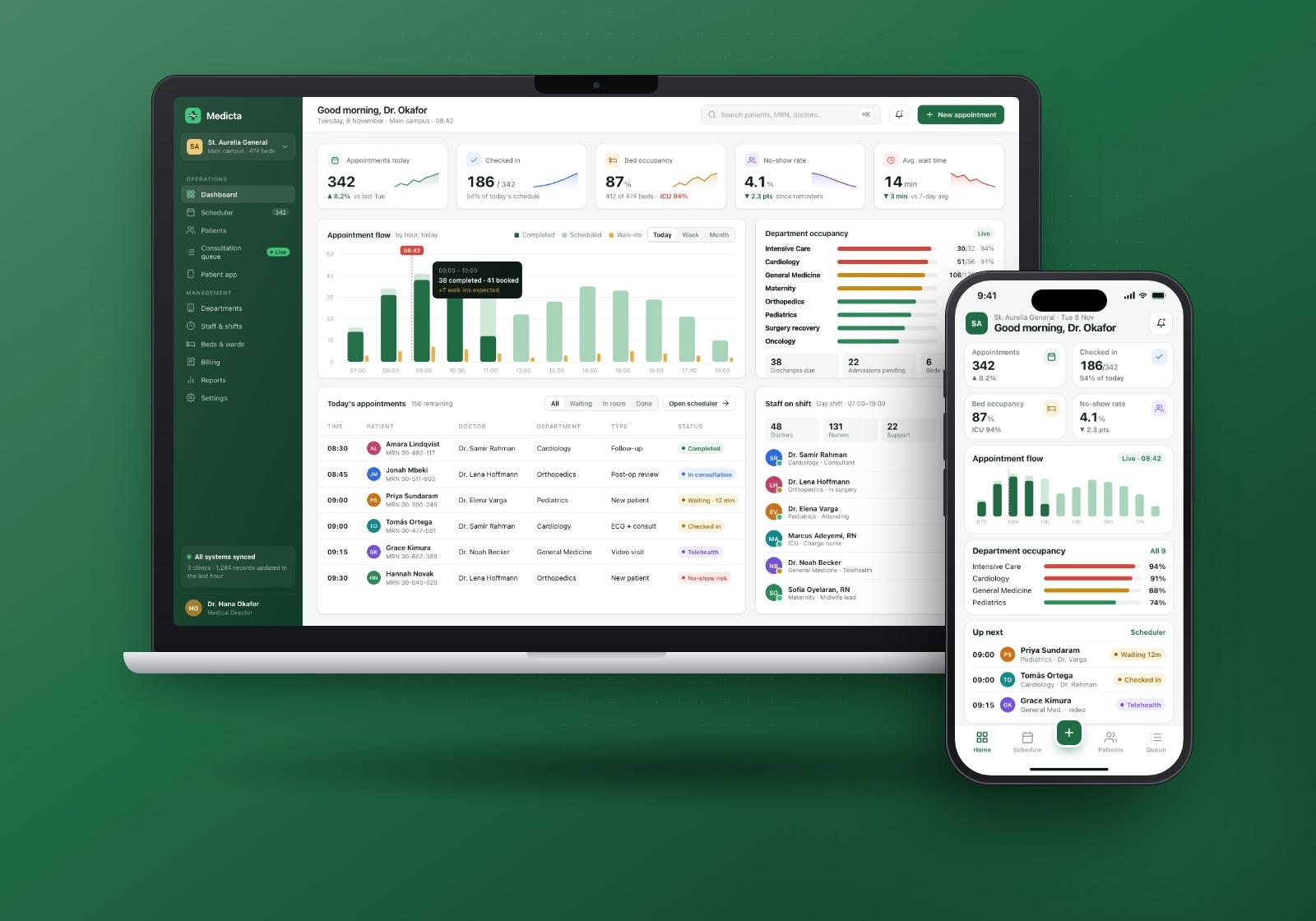
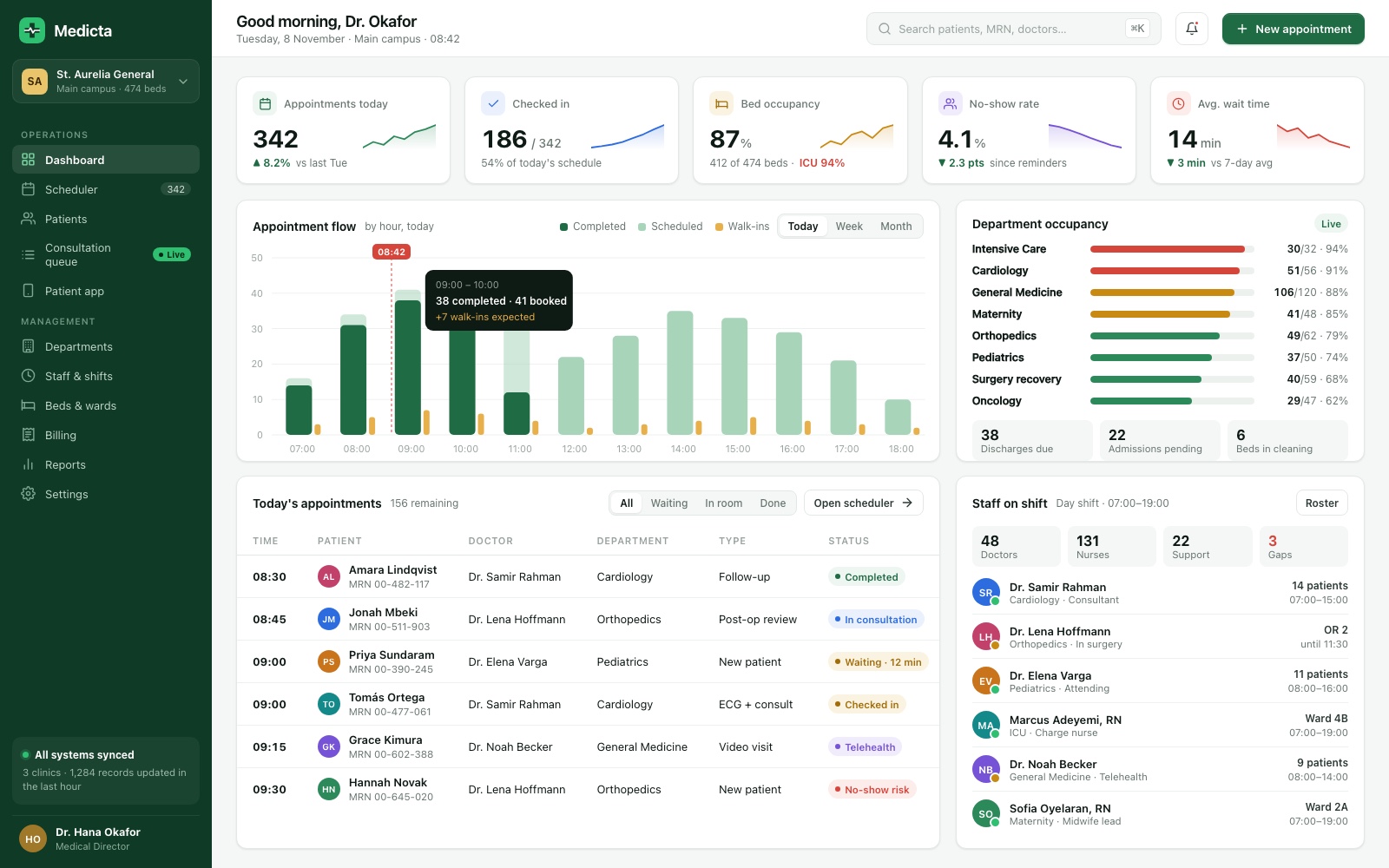
The dashboard gives administrators and medical directors a live view of the day. Headline cards cover appointments, check-ins, bed occupancy, no-show rate and average wait time, with an hourly appointment-flow chart underneath.
- Department occupancy with bed counts and discharges, admissions and cleaning status
- Today's appointments with status per patient, from checked in to in consultation
- Staff on shift, including coverage gaps
Appointment scheduler
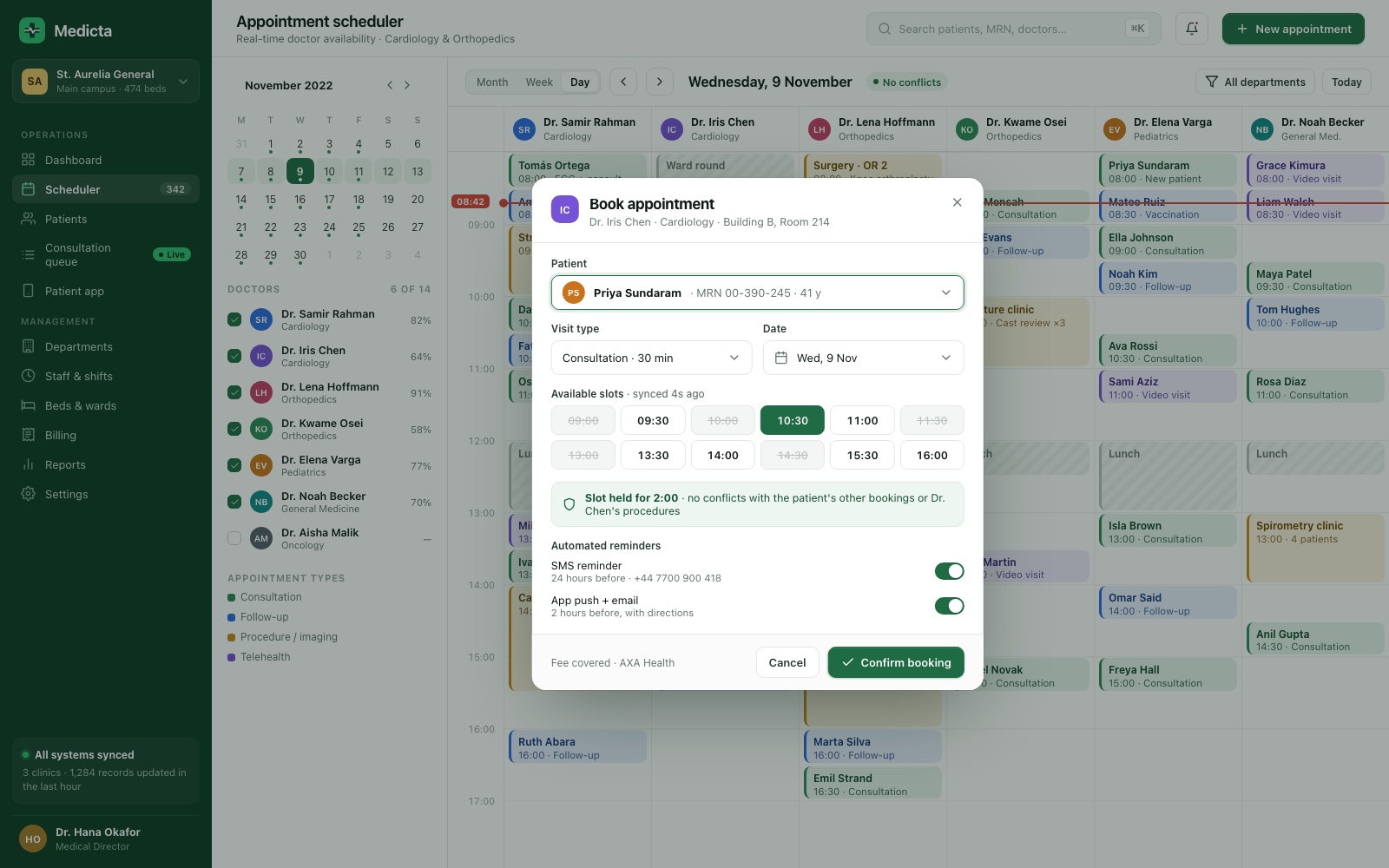
The scheduler shows real-time availability for multiple doctors side by side in a day, week or month view. Booking happens in a modal that lists only valid slots for the chosen doctor and visit type, holds the selected slot briefly while the booking is completed, and confirms there are no conflicts with the patient's other bookings or the doctor's procedures.
- Unavailable slots are shown but cannot be selected
- SMS and app push/email reminders are toggled on as part of the booking
- Filters by department and doctor keep large calendars manageable
Patient record
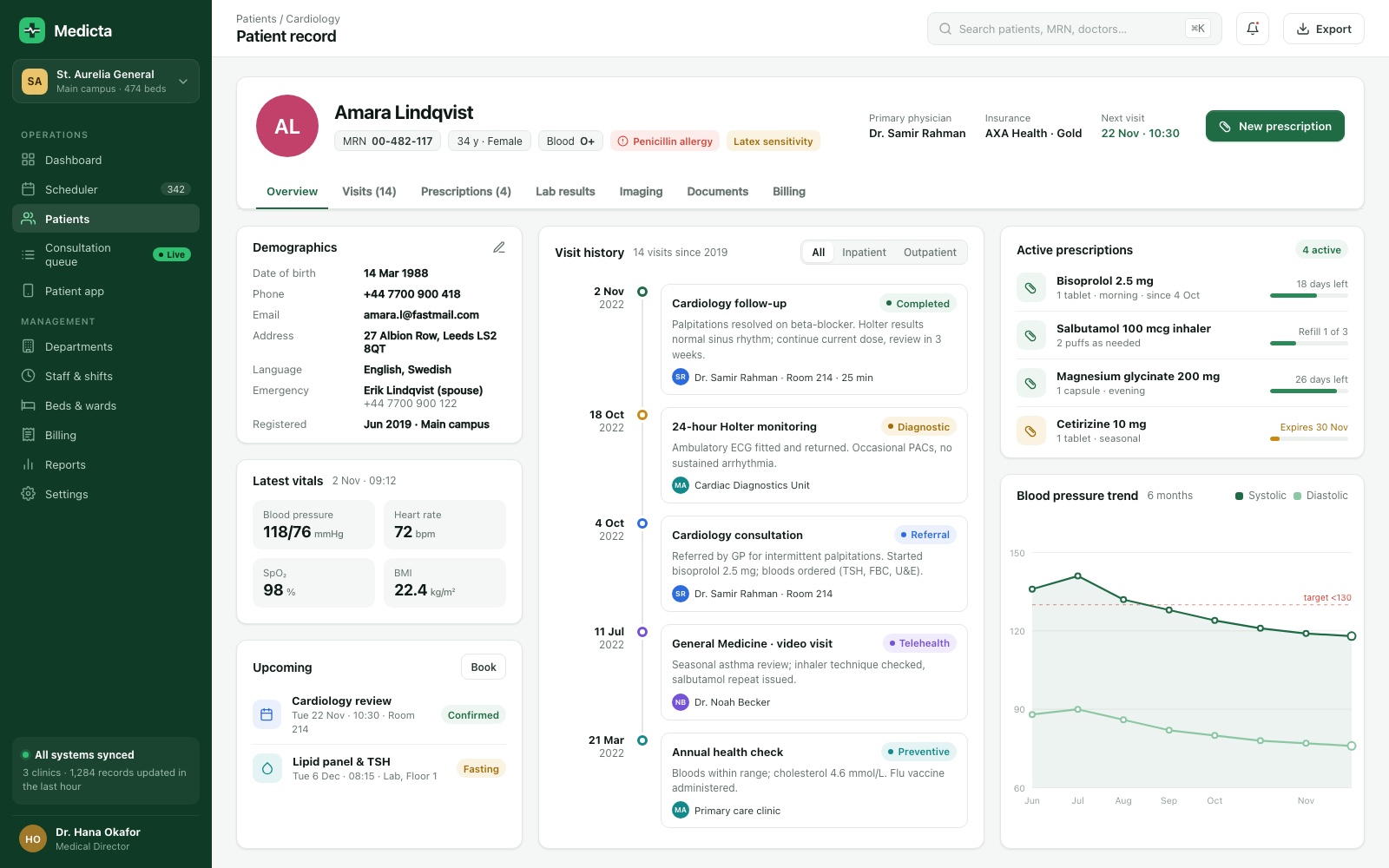
Each patient has a single record that staff can read at a glance. Allergies and sensitivities are flagged next to the patient's name, and the primary physician, insurance and next visit sit in the header.
- Demographics, latest vitals and upcoming appointments
- A visit history timeline with notes from each encounter
- Active prescriptions with refill and expiry status, plus a blood pressure trend
Live consultation queue
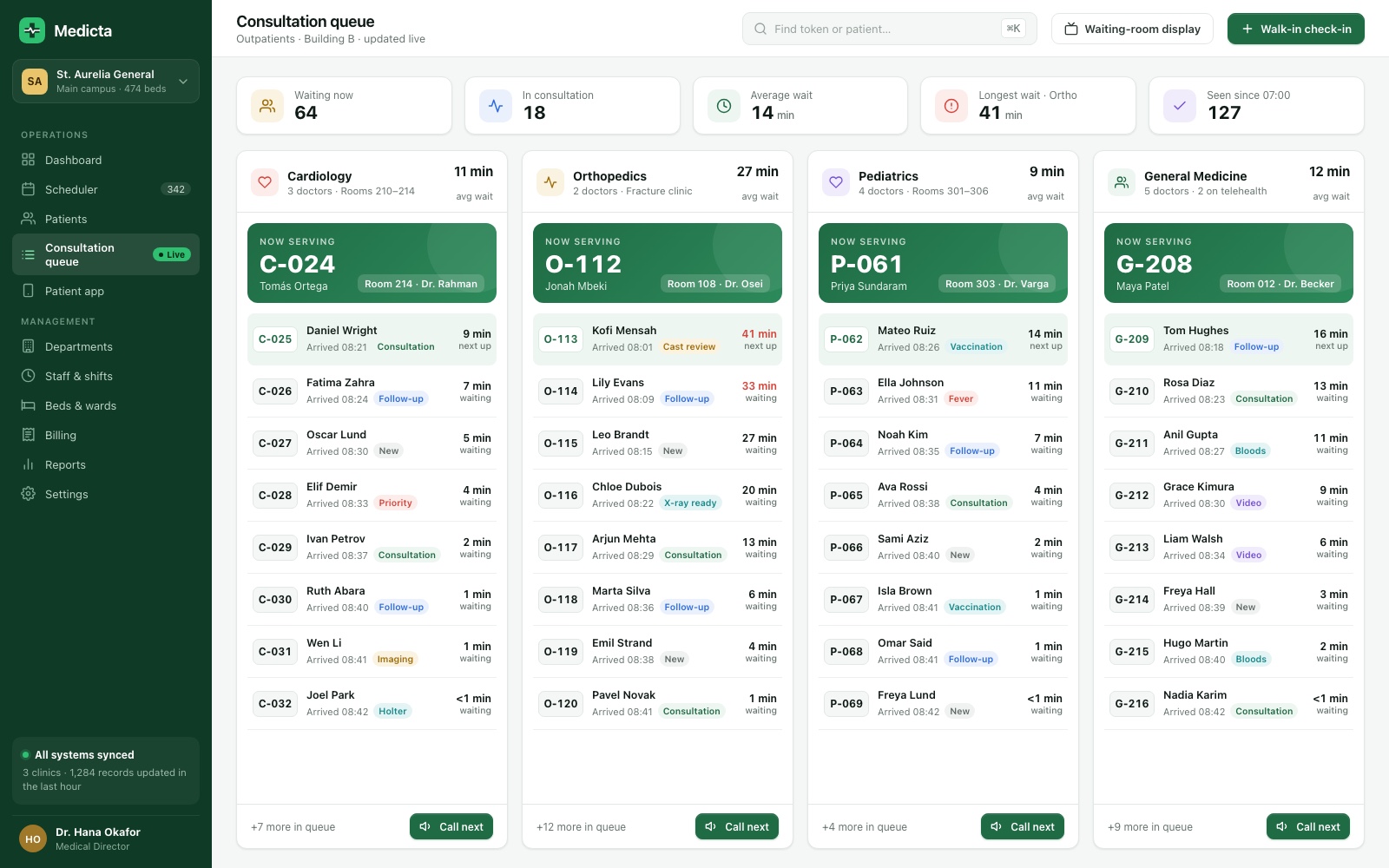
The consultation queue shows the waiting list for each department as it changes. Each column shows who is being seen now, in which room and by which doctor, followed by the queue in order with arrival times and visit types.
- Summary of patients waiting, in consultation and seen so far, plus average and longest wait
- "Call next" per department, and walk-in check-in from the same screen
- A waiting-room display mode for public screens
Patient booking on mobile
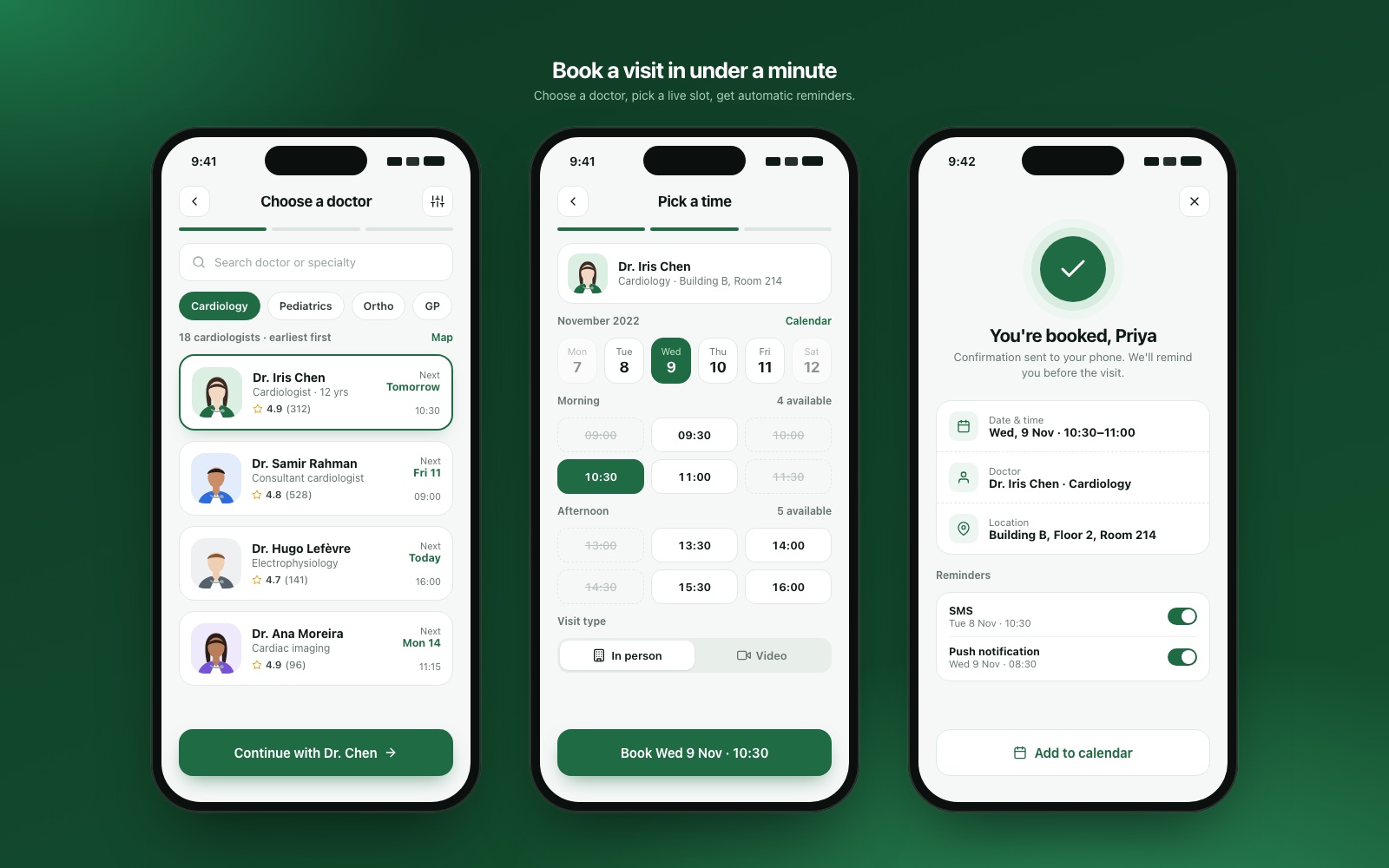
For patients, booking is three steps: choose a doctor, pick a time, get a confirmation. Patients can filter doctors by specialty and see each one's next available slot. They then pick from the live slots for in-person or video visits, and the confirmation screen shows the date, doctor, location and scheduled reminders.
Under the hood
- Multi-tenant SaaS architecture. The platform scales across clinics and hospitals while keeping strict data isolation and security between institutions.
- Real-time scheduling engine. Doctor availability and patient requests are matched live, so the staff scheduler and the patient app always show the same slots and conflicts are prevented before they happen.
- High-concurrency workflow automation. Patient records, department shifts and consultation queues stay synchronized across the institution even with many staff working in them at the same moment.
- Automated reminders. Reminders are created as part of each booking and sent through multiple channels, so they do not rely on manual follow-up.
Results
Medicta gave its institutions operational clarity. A single source of truth replaced their fragmented manual processes and cut administrative errors by 40%.
- 40% fewer administrative errors after centralizing intake, scheduling, records and shifts.
- Fewer no-shows, driven by the conflict-free booking engine and automated reminders.
- A better patient experience. Simpler booking raised patient satisfaction and improved clinic throughput.