Real Estate · Web · 2022
Acaraat
A real estate platform connecting developers, agents and buyers, with smart property filtering, inventory management and an agent referral system.
Overview
Acaraat is a real estate platform built around the lifecycle of construction projects. It connects three groups that have to work together to sell a unit: developers who build and release inventory, brokerage agents who bring in buyers, and the buyers themselves. Pre-construction and newly developed projects are hard to market, so Acaraat gives all three a central hub to manage, market and buy real estate units.
We designed and built the platform: a public marketplace with smart property filtering, detailed project and unit pages, an agent referral dashboard with commission tracking, and inventory tools for developers.
The challenge
Selling pre-construction and new developments relied on static listings and offline coordination. Each group in the deal was missing something important.
- Buyers lacked transparency. A static listing says little about construction progress, which units are still available, or how a payment plan works.
- Agents had no clear way to track referrals and commissions. Leads and deals lived in spreadsheets and messages, and commission was hard to see until after the fact.
- Developers couldn't see market interest in real time. Without live demand signals, decisions about pricing and releasing units were made blind.
The difficulty was serving all three from one system without it turning into three disconnected products. A unit reserved through an agent has to show up as reserved on the developer's inventory and disappear from the buyer's search, immediately and accurately.
Goals
- Turn static listings into a dynamic, interactive marketplace.
- Let buyers search large inventories precisely and decide with confidence.
- Give agents a clear view of their leads, referrals and commission.
- Give developers direct control over inventory and live insight into demand.
- Build transparency and trust into every project page.
Our approach
We treated the unit as the shared object at the center of the platform. Buyers browse it, agents refer clients to it, and developers price, release and track it. Designing every screen around the same unit data kept the three experiences consistent: availability, pricing and status are the same wherever they appear.
For buyers, we focused on search and trust. Inventories are large, so filtering had to be granular, and pre-construction purchases carry risk, so project pages put construction progress, payment plans and amenities up front rather than behind an enquiry form.
For agents and developers, we built working dashboards, not brochures. The agent view is organized around the sales pipeline and commission, and the developer view around inventory status and demand. Each answers the questions those users ask every day without needing a separate report.
What we built
Smart property search
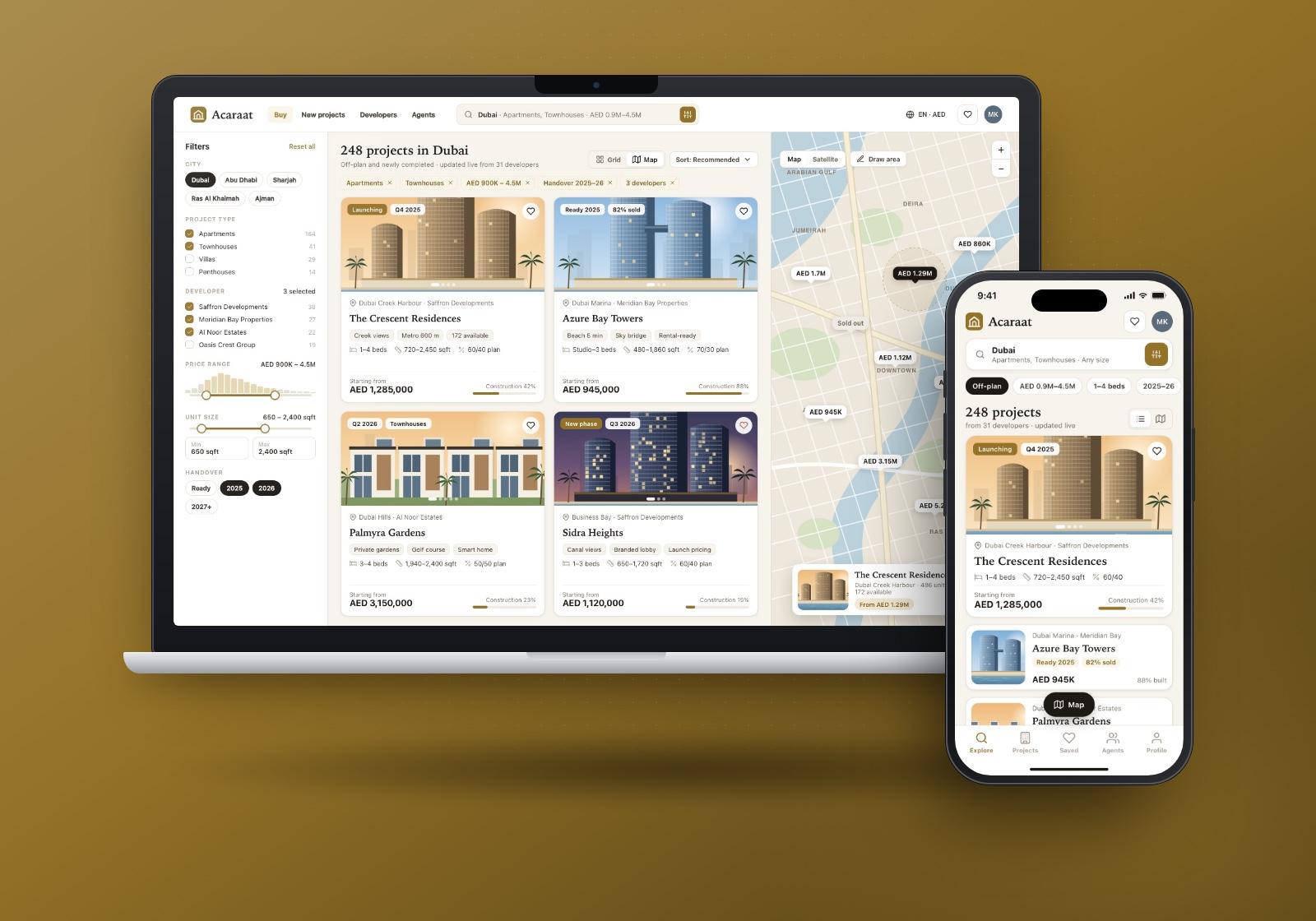
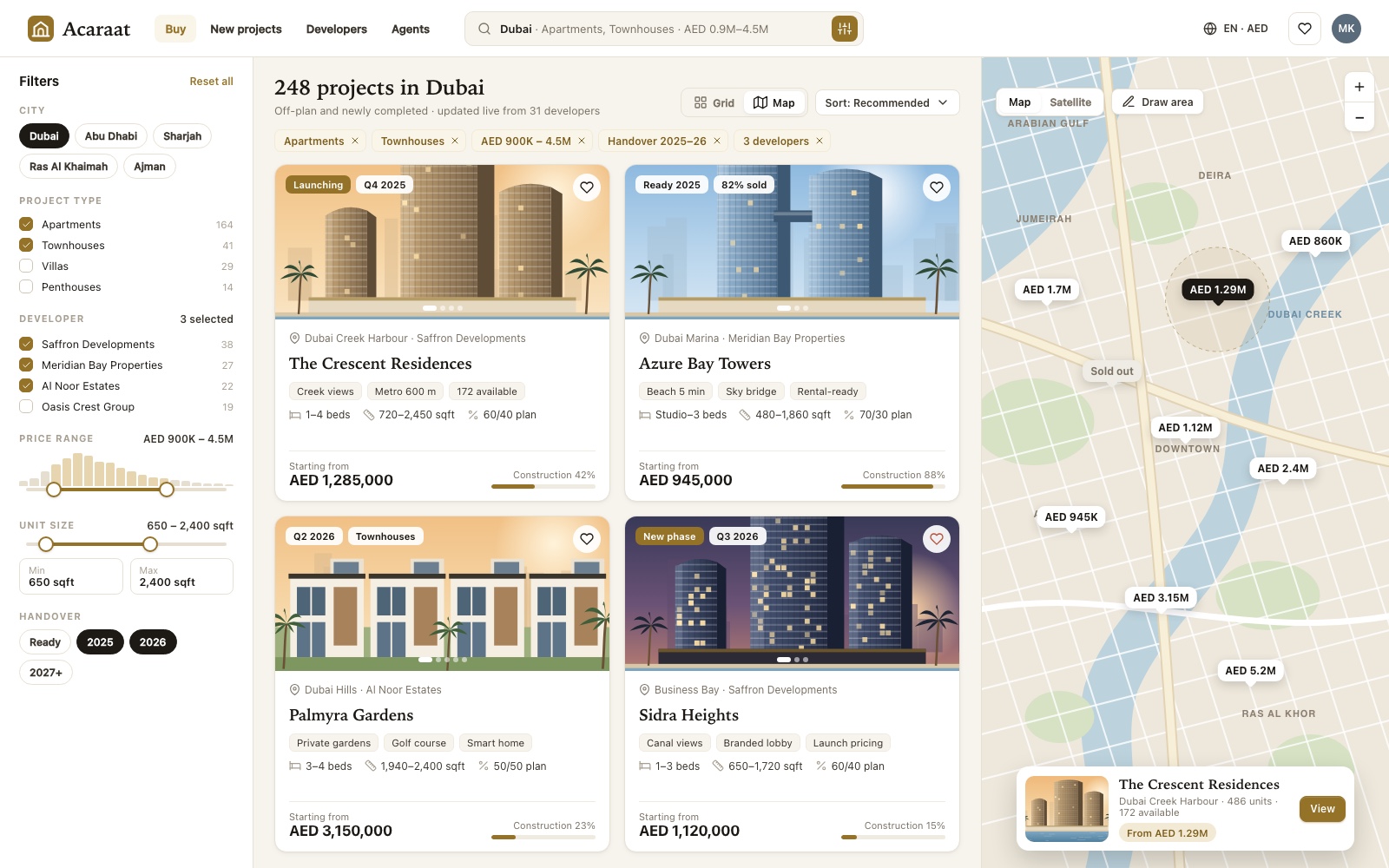
Buyers search across projects with a filter sidebar covering city, project type, developer, price range and unit size, plus handover timing. Active filters appear as removable chips, and results can be shown as a grid or alongside a map with price pins.
- Project cards show starting price, unit mix, size range, payment plan and construction progress
- Live availability per project, so buyers don't spend time on sold-out stock
- Map view with area drawing for location-led searches
Project showcase
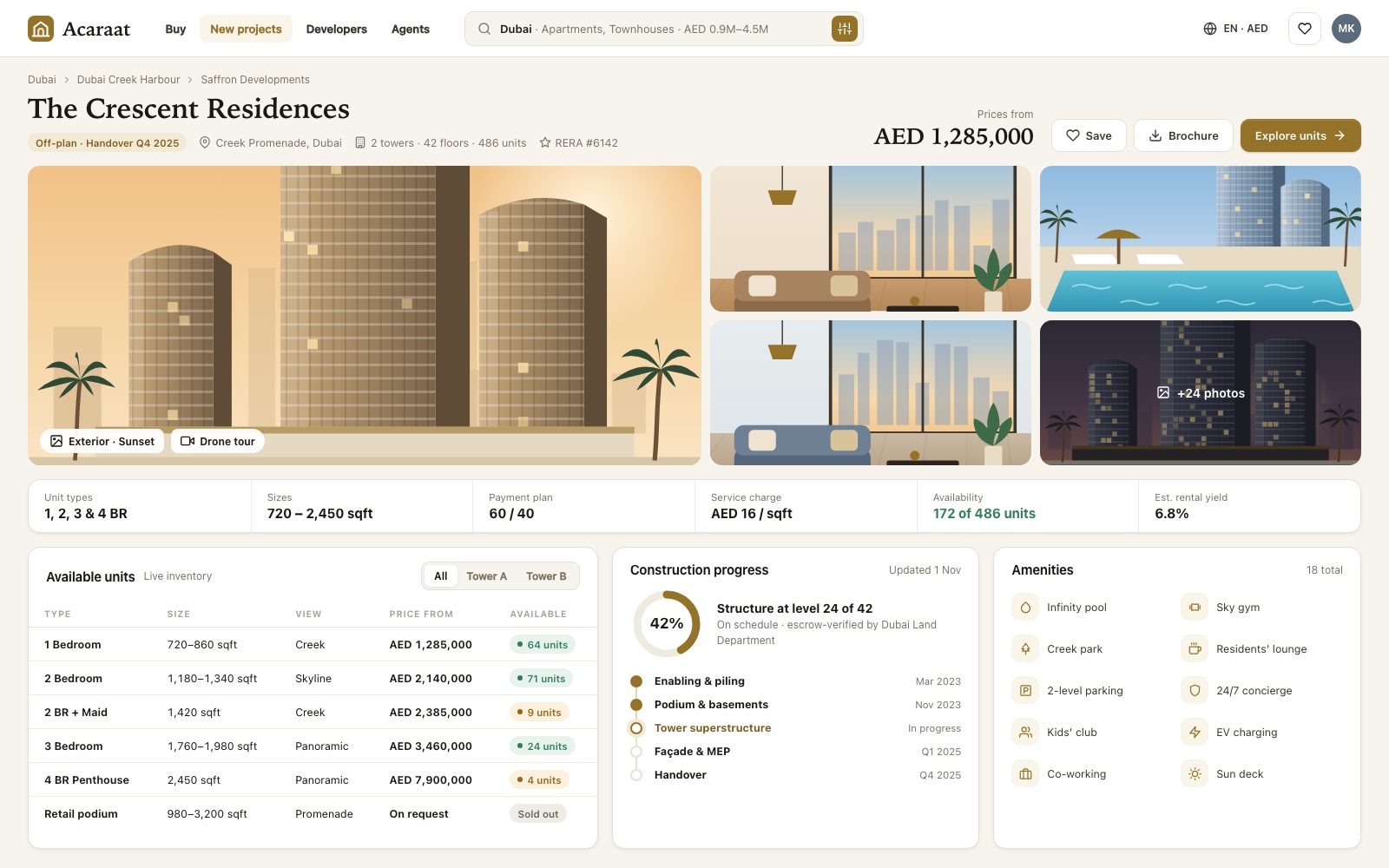
Each project gets a detailed page covering construction details, amenities and unit specifications. A hero gallery leads into key facts such as unit types, sizes, payment plan and live availability.
- Available units by type, with sizes, views, starting prices and remaining stock
- A construction progress tracker with completed and upcoming milestones
- A full list of amenities, plus brochure download and saving the project
Unit detail and floor plan
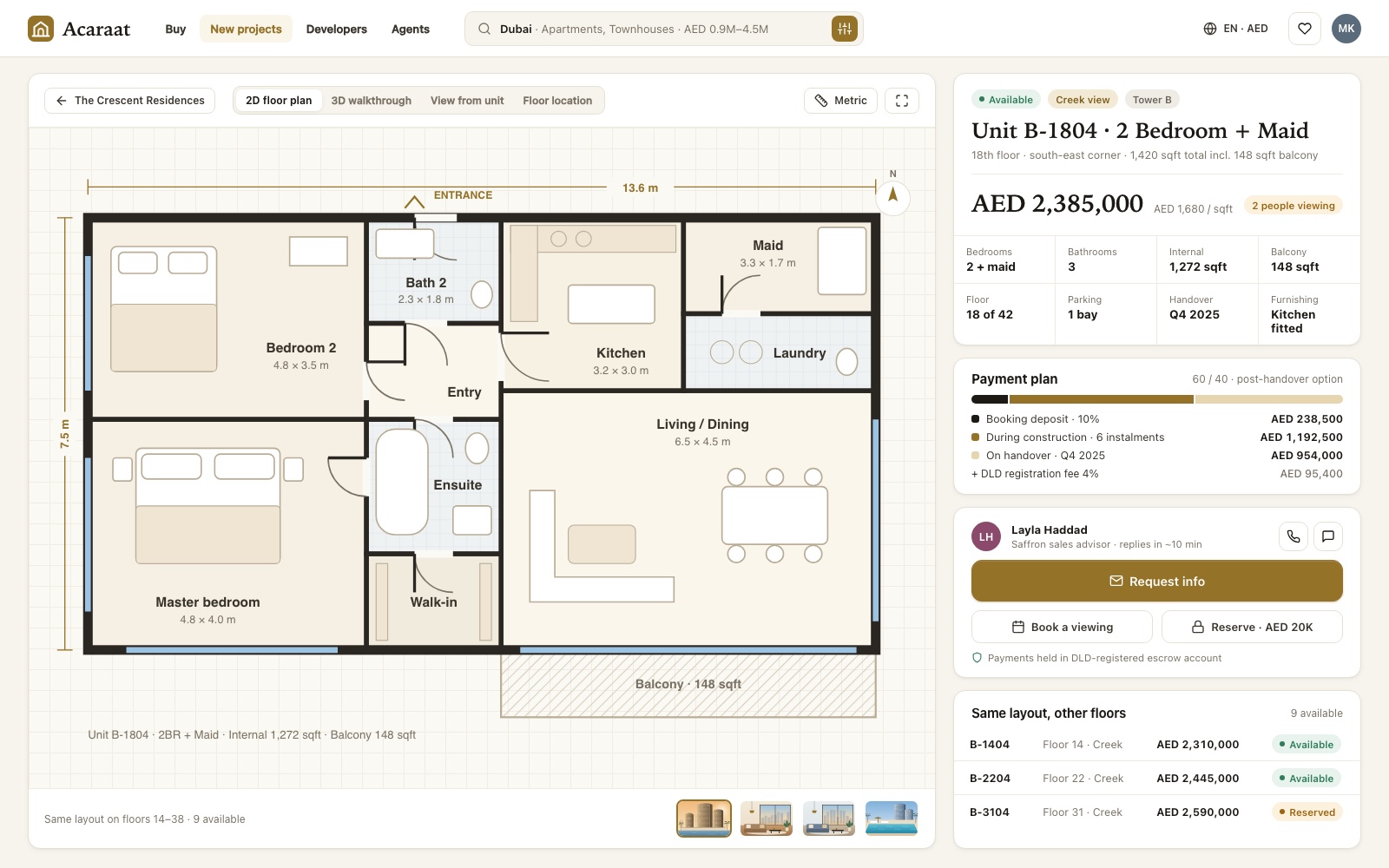
Buyers can drill down to a single unit. The floor plan shows room dimensions and orientation, next to the unit's specifications, price and payment-plan breakdown. A Request info call to action connects the buyer with a sales advisor, alongside options to book a viewing or reserve.
- Bedrooms, bathrooms, internal and balcony area, floor, parking, handover and furnishing
- Payment schedule split by milestone
- Units with the same layout on other floors, with their own price and status
Agent referral dashboard
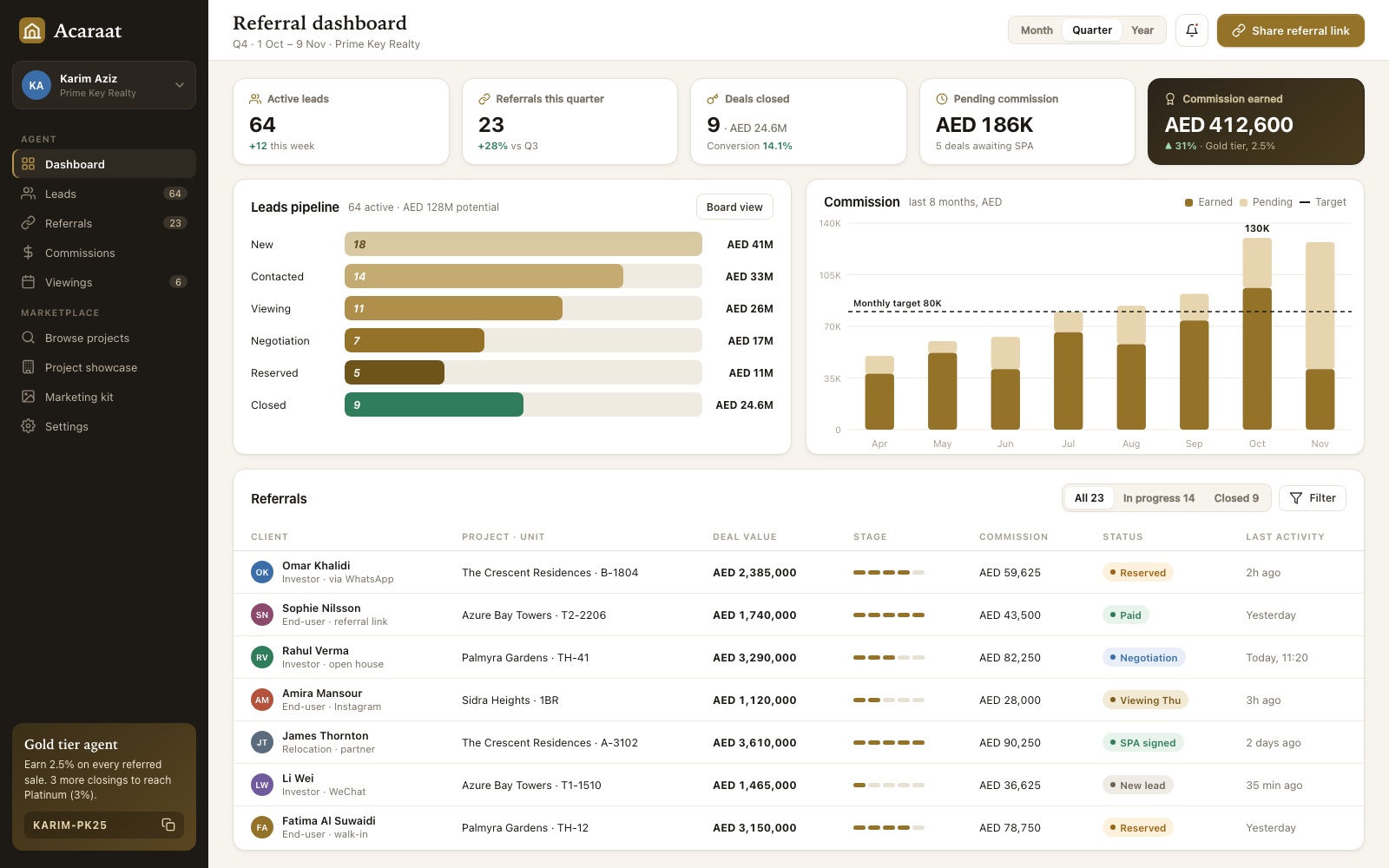
Agents get a dashboard to track leads, manage client referrals and see their commission through clear charts. A pipeline shows leads at each stage from new to closed, with the potential deal value at every step.
- Commission chart showing earned and pending amounts against a monthly target
- Referral list with client, project and unit, deal value, stage, commission and status
- A shareable referral link and code for bringing in new clients
Developer inventory and demand
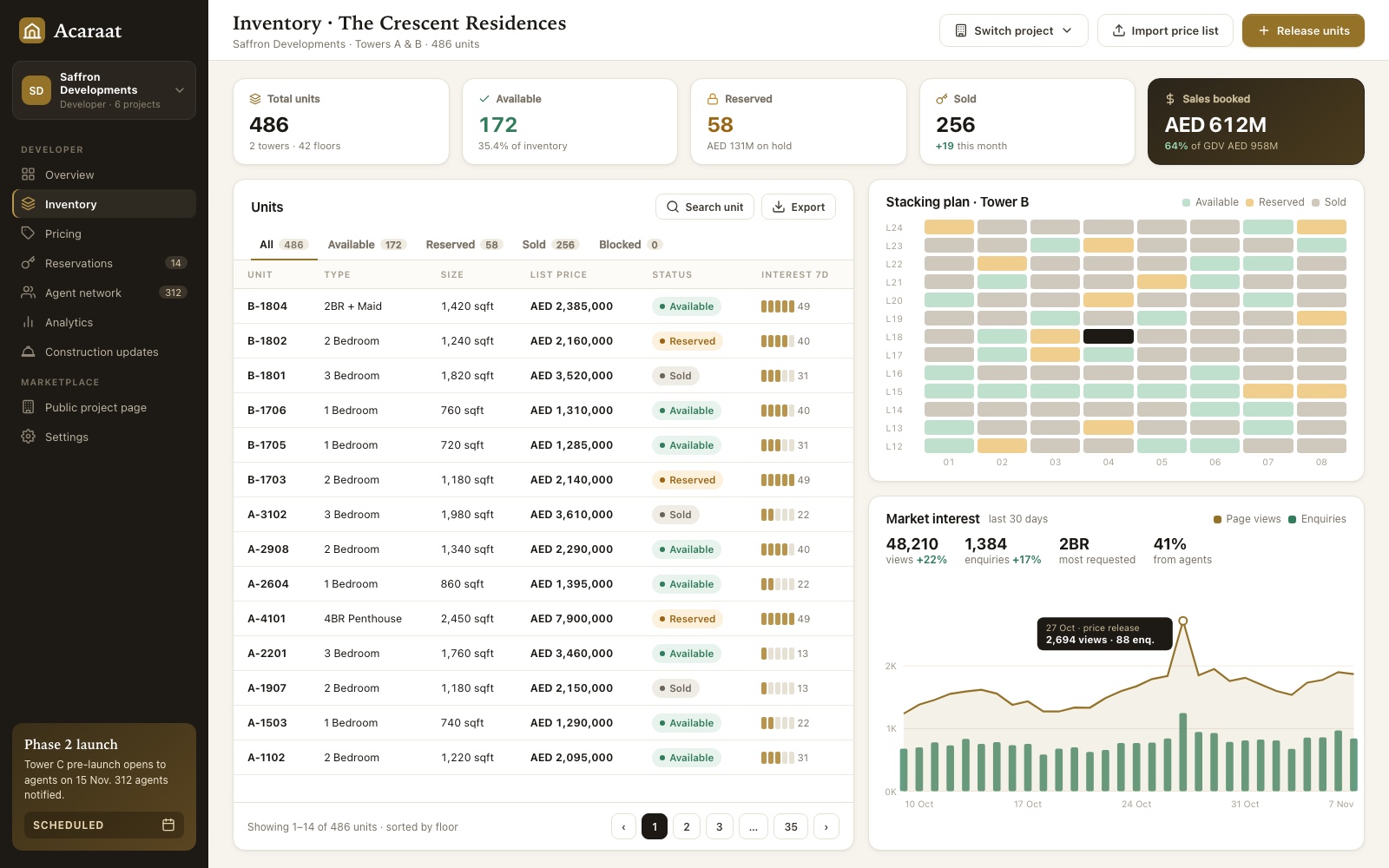
Developers manage inventory listings from a dedicated workspace. A units table shows every unit's type, size, list price and status (available, reserved, sold or blocked), with an interest indicator for each unit.
- A stacking plan that shows the status of every unit by floor
- Market interest analytics tracking page views and enquiries over time
- Tools to import price lists and release new units
Under the hood
- One shared inventory model. Buyer search, project pages, agent referrals and developer tools all read from the same unit records, so status and pricing stay consistent everywhere.
- Granular search over large inventories. Filters combine several dimensions at once (city, type, developer, price, size) so buyers can narrow large inventories precisely.
- Real-time demand signals. Buyer activity on project and unit pages feeds the developer's market-interest view, turning browsing into usable data.
- Role-based workspaces. Buyers, agents and developers each get an experience shaped around their own work, all on a single platform.
Results
By digitizing the traditional property sales workflow, Acaraat removes friction from buying real estate. Static listings became a dynamic, interactive marketplace.
- Faster sales for agents. Referral tracking and clear commission visibility help agents sell faster.
- More confident buyers. Detailed project pages, live availability and construction progress give buyers the transparency to decide with confidence.
- Better-informed developers. Developers now control their inventory directly and see market interest in real time instead of relying on offline feedback.